
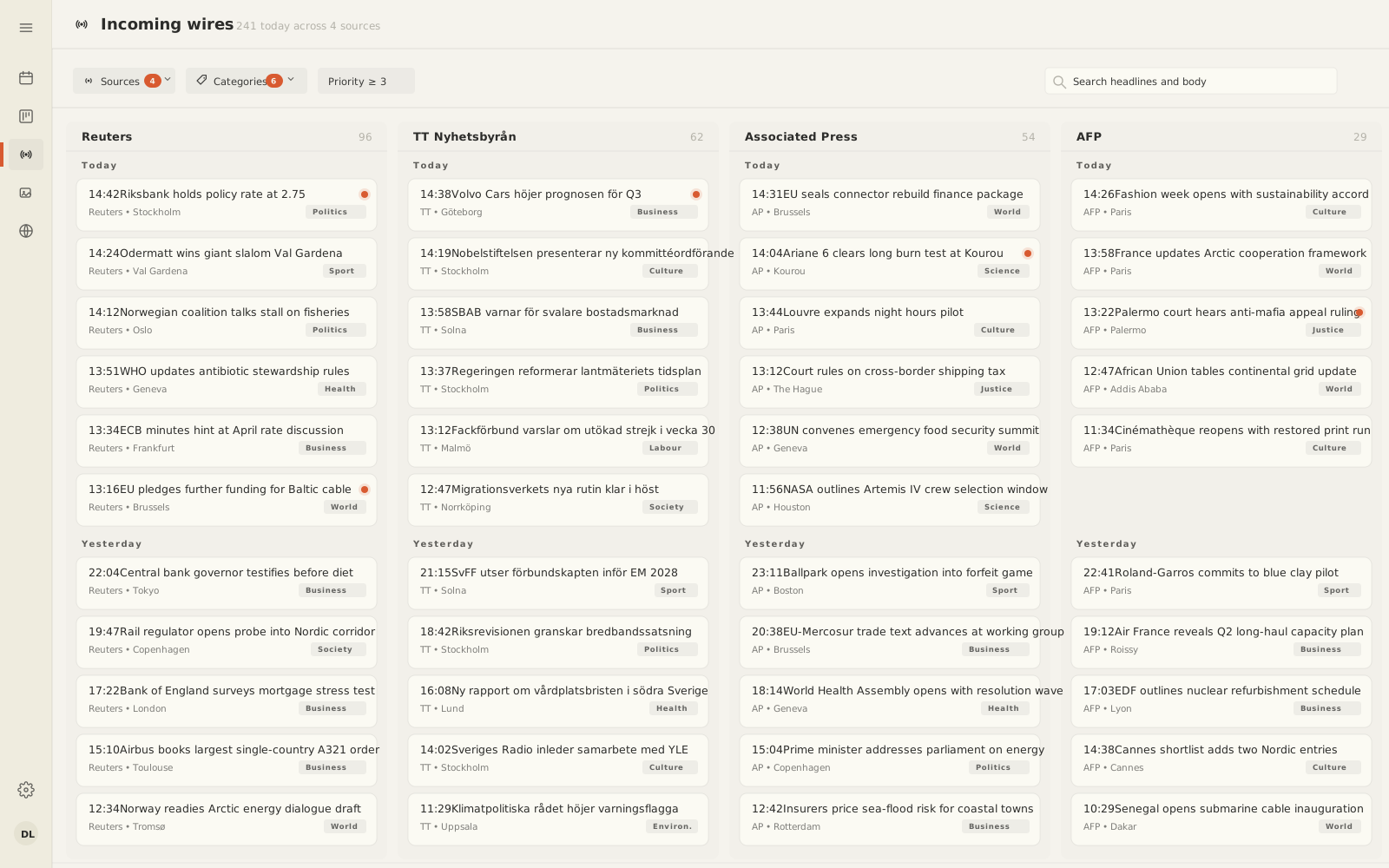
Wire ingest
Reuters, TT, AP or your in-house feed.
Wires land as drafts, categorised and prioritised on arrival. The ember dot marks items where AI is still working; everything else is ready for a human pass.
Editorial software
Write, edit and publish in one place. A solo journalist can be running instantly. A larger newsroom sets up its own editorial workflow, wire coverage and AI - matching how the desk already works.

Photo by Israel Andrade on Unsplash
Two shapes
A solo journalist wants to write and publish without a training course. A larger newsroom wants a planning desk, an editorial workflow, permissions and an audit trail. Tidenda gives you both. A single setting decides which shape your team sees, and you can switch it at any time.

Photo by Brooke Cagle on Unsplash
One-person publications
Planning and workflow controls stay out of the way. A solo reporter or a two-person newsletter can start writing straight away.

Photo by Arlington Research on Unsplash
Larger newsrooms
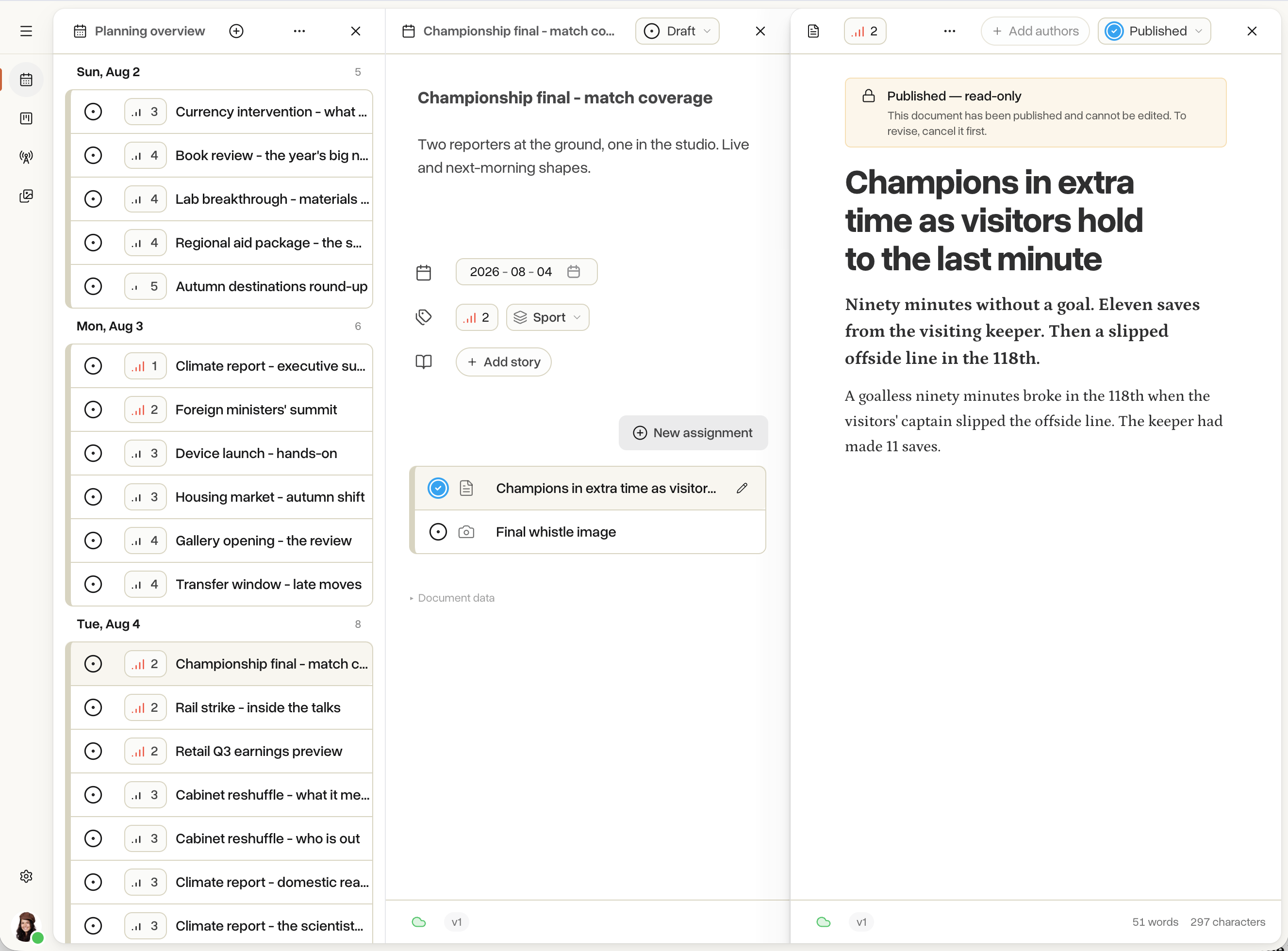
Plan the day as a list of stories and assignments. Each article moves through the workflow your newsroom defines, and permissions decide who can move it forward.
Editorial surface
Headlines, article text, bylines, planning items, tags - everything the newsroom edits happens live. You see each other's cursors as you type, and each person's undo history is their own, so nobody wipes anyone else's work by accident. The same layout adapts from a reporter's phone in the field to a four-monitor desk, without a separate mobile app.
Wires and AI
Subscribe to Reuters, TT, AP or an in-house feed. Wire items land already tagged with an IPTC topic and a priority. Any step in your workflow can trigger AI - translate a wire, summarise it, or rewrite it in your house voice - so a draft is on the editor's desk ready for a human pass.
Wire ingest
Wires land as drafts, categorised and prioritised on arrival. The ember dot marks items where AI is still working; everything else is ready for a human pass.
AI in the workflow
Pick a workflow step - "when a wire lands", "when an editor approves" - and choose what should happen: translate, categorise, rewrite or summarise.
Bring your own provider
Any compatible service, or the models bundled with Tidenda that run locally at no per-request cost. API keys stay inside your organisation.

Photo by Anastasiia Nelen on Unsplash
Assets
Photographs, illustrations and graphics live inside the newsroom, next to the articles that use them. Captions, rights and photographer credit stay attached wherever the image travels. Every upload gets an Ed25519 signature so anyone republishing downstream can prove it has not been altered. If a file arrives with a C2PA manifest, we validate it and pass it through untouched.
Publisher
Turn on the publisher and your organisation has a working public site immediately. No servers to run, no build to configure, no separate stack to maintain. When you are ready, point your own domain at it - add a DNS record and we handle verification and HTTPS certificates for you.
Or your own site
Running WordPress, a custom CMS, or a static-site generator? Every time an article is published, Tidenda sends a signed snapshot to the endpoint you name. Your existing site keeps its templates, its URLs and its ops - it just gets clean editorial content from a proper editorial tool. Use the built-in Publisher, your own stack, or both side by side.
Signed article payloads
Every delivery carries the full article JSON plus embedded assets, HMAC-signed on the request and Ed25519-signed on the snapshot. Verify in any language.
Idempotent, replayable
Retries carry the same delivery id, so your receiver is safe to make idempotent. Any past delivery can be replayed from the admin UI.
Tool for the whole newsroom
Planning, writing, wire coverage, AI, images, and a public site - one place, one login.
Servers to run
The publisher, the collab surface, and the wire ingest are managed for you. Point a DNS record and you have a live site.
Free for the first seat
Sign up, publish an article, invite a colleague. Payment starts on the second seat, and only after your first year.
Integrations
When an article moves through your workflow, a webhook fires and lets your systems - a print system, an archive, an analytics pipeline - react. Every delivery is cryptographically signed, so receivers can verify it came from you. Failed deliveries retry automatically, and any event can be replayed from the admin UI. If you need to push content the other way round - wires, planning items, articles - a scoped API key does the work.
Each delivery is signed HMAC-SHA256 on the request and Ed25519 on the article snapshot. Receivers verify authenticity in any language. Deliveries are idempotent and replayable.
Webhook docsPush documents into your organisation via a scoped API key. Good for custom wire importers, upstream editorial systems, and migrations from a legacy tool.
API referenceReady when you are
Sign up, publish an article, invite a colleague. The first user is free for a year.